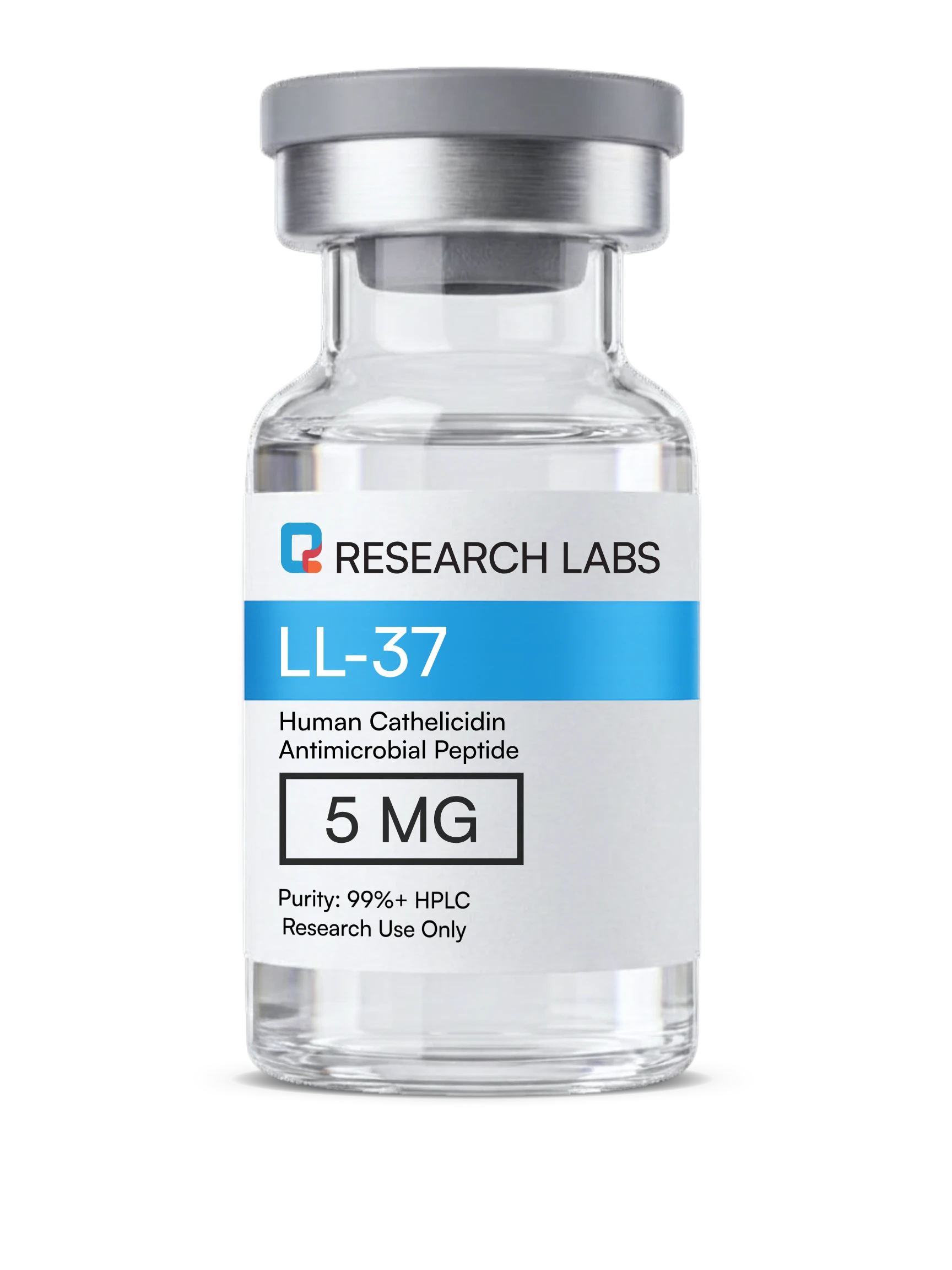
Quick Facts
- Type
- Single
- Category
- Recovery / Healing
- Vial Strength
- 5 mg
- Status
- Research
Research Purposes Only
This information is provided for educational purposes only. This content is not intended to diagnose, treat, cure, or prevent any disease. Always consult with qualified healthcare professionals.
Download Guide
Save the complete LL-37 5mg research guide as a PDF.
Educational and research use only. Not medical advice.
Reference
Sources used for this guide are listed in our research database .
What Is LL-37 5mg?
LL-37 5mg Vial Overview
LL-37 is a 37-amino acid antimicrobial peptide and the only human cathelicidin. It plays a crucial role in innate immunity by directly killing bacteria, viruses, and fungi through membrane disruption. Beyond antimicrobial activity, LL-37 modulates immune responses, promotes wound healing through angiogenesis, and influences tissue remodeling.
LL-37 5mg Quick Reference
LL-37 5mg Vial Specifications
- Peptide
- LL-37 (5 mg Vial) (NNMT inhibitor)
- Vial Content
- 5 mg total peptide
- Category
- Recovery / Healing
- Administration Method
- Subcutaneous injection
- Common Use Case
- Immune defense, antimicrobial activity, and wound healing
LL-37 5mg Compared With Other Formats
Details that distinguish this 5 mg format include:
- Only human cathelicidin antimicrobial peptide
- Broad-spectrum activity against bacteria, viruses, and fungi
- Immune modulation beyond direct antimicrobial action
How Does LL-37 Work?
LL-37 Mechanism of Action
LL-37 kills pathogens by disrupting microbial membranes through electrostatic interaction with negatively charged lipid bilayers. Beyond antimicrobial activity, it activates formyl peptide receptors (FPR2), recruits immune cells, promotes angiogenesis for wound healing, and disrupts bacterial biofilms. It bridges innate and adaptive immunity.
What Are the Potential Benefits of LL-37?
LL-37 Research Findings and Observed Outcomes
Findings and reported areas of study for LL-37 (5 mg Vial) include:
- Broad-spectrum antimicrobial activity
- Biofilm disruption
- Wound healing promotion
- Immune cell recruitment and activation
These observations are discussed for research and educational reference only and are not medical claims.
What Do You Need to Reconstitute LL-37 5mg?
LL-37 5mg Supplies for Reconstitution and Handling
- •Insulin syringes (29–31 gauge)
- •Bacteriostatic water
- •Alcohol prep pads
- •Sharps container
Supplies listed are for laboratory handling and research preparation purposes only.
LL-37 5mg Administration and Research Protocol
LL-37 Injection Route, Frequency and Timing
Low doses are typical due to potency. Rotate injection sites.
LL-37 5mg Dosage Guide
LL-37 Dosage Ranges
The ranges below pair the listed dose with the draw volume for this product strength.
LL-37 5mg Dosage to Syringe Units
Based on reconstitution below
| Target Daily Dose | Draw Volume | Units |
|---|---|---|
| 50 mcg | 0.02 mL | 2 units |
| 100 mcg | 0.04 mL | 4 units |
| 200 mcg | 0.08 mL | 8 units |
This dosing table is unique to the 5 mg vial. Units refer to markings on a standard U-100 insulin syringe (1 unit = 0.01 mL).
How Long Does a LL-37 5mg Vial Last?
LL-37 5mg Duration by Research Dose
At common research doses, one 5 mg vial of LL-37 typically supports:
Short cycles of 2–4 weeks are common for immune support.
How to Reconstitute LL-37 5mg
LL-37 5mg Reconstitution With Bacteriostatic Water
This section applies specifically to the LL-37 (5 mg Vial).
- Recommended Diluent
- Bacteriostatic water
- Diluent Volume
- 2 mL
- Final Concentration
- 2.5 mg/mL
LL-37 5mg Mixing Instructions
- 1Remove the vial from storage and allow it to reach room temperature (10–15 minutes).
- 2Wash hands thoroughly and prepare a clean workspace with all supplies.
- 3Using a sterile syringe, draw the appropriate volume of bacteriostatic water.
- 4Clean the rubber stopper of the vial with an alcohol prep pad.
- 5Insert the needle at a slight angle and slowly inject the diluent down the inner wall of the vial.
- 6Gently swirl or roll the vial until fully dissolved; the solution should appear clear and colorless.
- 7Label the vial with reconstitution date and refrigerate at 2–8 °C (35.6–46.4 °F), protected from light. Use within 2–4 weeks.
LL-37 Stacks and Research Combinations
LL-37 and Compatible Research Pairings
In research settings, LL-37 (5 mg Vial) is sometimes paired with peptides such as:
- Thymosin Alpha-1: Comprehensive immune enhancement
- BPC-157: Tissue repair alongside immune defense
Factors That May Affect LL-37 Research Outcomes
Supporting Factors for LL-37 Research
Factors recorded alongside this protocol include:
- Immune-supportive nutrition
- Adequate sleep
- Stress management
- Avoid immunosuppressants if possible
These factors can affect how research observations are interpreted.
LL-37 Side Effects and Safety Considerations
LL-37 5mg Tolerability Notes
LL-37 may cause injection site reactions at higher doses due to its membrane-active nature.
Some individuals report:
- Injection site redness and warmth
- Mild inflammatory response at injection site
- Temporary discomfort
How to Store LL-37 Before and After Reconstitution
LL-37 5mg Storage Requirements
- Unreconstituted
- Store frozen at −20°C
- Reconstituted
- Refrigerate at 2–8°C
- Post-Mix Stability
- Up to 3–4 weeks reconstituted
Who Should Avoid LL-37?
This peptide is generally not recommended for:
- Pregnant or breastfeeding individuals
- Those with autoimmune conditions
- Anyone advised otherwise by a healthcare professional
LL-37 5mg FAQs
Can LL-37 replace antibiotics?
No. LL-37 is a research compound and not a substitute for prescribed antibiotics. It is studied for its complementary immune-enhancing properties.
Why are doses so low compared to other peptides?
LL-37 is highly potent at microgram levels. Its membrane-active mechanism means excessive doses could cause tissue irritation.
Where to Buy LL-37 5mg for Research
LL-37 5mg Purchasing and Research Supply Notes
Before ordering LL-37 (5 mg Vial), review the product label, available testing documents, and storage instructions.
Check the ResearchLabs listing for:
- Available testing documents
- Product strength and concentration
- Storage and handling instructions
- Current product availability
View the current listing for LL-37 (5 mg Vial):
→ View on ResearchLabsConfirm the product strength and storage requirements before ordering. Products are for laboratory research only and are not for human consumption.
Quick Facts
- Type
- Single
- Category
- Recovery / Healing
- Vial Strength
- 5 mg
- Status
- Research
Research Purposes Only
This information is provided for educational purposes only. This content is not intended to diagnose, treat, cure, or prevent any disease. Always consult with qualified healthcare professionals.
Download Guide
Save the complete LL-37 5mg research guide as a PDF.
Educational and research use only. Not medical advice.
Reference
Sources used for this guide are listed in our research database .